How I Use Tello to Keep a US Phone Number While Living Abroad
Written by Rita Serra | Published Aug 11, 2026
Heads up! This post contains affiliate links, which means I may earn a small commission if you purchase at no extra cost to you. I only recommend what I truly believe in, and your support helps keep this site running and free to access.
- Why keep a US phone number when you live abroad
- What is Tello?
- Exactly how I use it
- Does Tello work abroad? My experience using it in Albania
- The honest limitations
- Alternatives I looked at
- So, is Tello worth it?
- FAQ
- Can I keep my US phone number while living abroad?
- Can I keep my existing US number with Tello?
- Does Tello work outside the US?
- Will I still get bank verification and 2FA codes on Tello from abroad?
- Does Tello work over wifi?
- How much does Tello cost per month?
- Is Tello better than Google Voice for expats?
If you are moving abroad, or already living abroad, keeping a US phone number is one of those boring logistics that matters far more than you expect. This is how I use Tello to keep a US phone number while living abroad for a few dollars a month. I have done it for a year from Saranda, so this is written from actually doing it, not from a comparison chart.
When I first moved, I kept paying T-Mobile. I was convinced I had to. My whole life was tied to that number: two-factor codes, bank logins, every account that texts you before it lets you in.
Losing it felt like locking myself out of my own accounts from 4,000 miles away. I also wanted a phone and data the second I landed back in the US, no scrambling for a SIM at the airport.
So I paid a full carrier bill for a number I barely used abroad. For way too long. Then I found Tello. Same job, a fraction of the price.
Why keep a US phone number when you live abroad
My instinct to hold onto the number was right. My instinct to keep paying T-Mobile for it was not.
Here is what a US number is still tied to, long after you have gone: your bank. Your credit cards. The IRS and anything tax-related. Every account that sends a verification code by text before it will let you log in.
A lot of US institutions will not send those codes to a foreign number, and some will not let you switch the number on file to a foreign one at all. So the US number is not nostalgia. It is the key that unlocks your own money from 4,000 miles away.
Nobody tells you this part before you go. You think the hard logistics are the visa and the plane ticket. The number is the one that quietly breaks things later, the day you try to log into your own bank, and the code goes to a phone number you no longer have. I kept mine so that day never came.
What is Tello?
Tello is a small US carrier that runs on T-Mobile’s network. In the industry, it is called an MVNO, which just means it rents space on a bigger network instead of owning towers.
For you, that means a real US phone number and a real US plan, at a fraction of what the big carriers charge.
The part that makes it work for expats: you build your own plan. You pick your minutes, your texts, and your data separately, and plans start at $5 a month with no contract and no lock-in. You can go as small as you want. If all you need is a US phone number that can receive a text, you are not paying for an unlimited plan you will never use from abroad.
That is the whole reason I landed on Tello. I did not want a second full phone plan. I wanted a US phone number kept on life support, cheaply, so my American accounts would keep talking to me.
One thing worth knowing before you sign up: you do not have to take the new number Tello gives you. You can port your existing US number over and keep it, which is the whole point for most people.
A few things make that go smoothly. Before you start, turn off any port protection or number transfer lock on your old account. Most carriers have it switched on by default now, and you can disable it by calling them or toggling it off online.
You will also need your account number and a transfer PIN from that carrier. And do not cancel your old service yourself. Let the port close on its own first, or you risk losing the number entirely.
Once your old carrier releases the number, the actual transfer into Tello’s system takes about two minutes, sometimes a little longer. You will know the moment it is done, because Tello sends you a confirmation email the second the port is officially successful.
Exactly how I use it
Here is my actual setup, not the theoretical version.
I did not switch cold. When I first found Tello, I decided to keep my T-Mobile SIM running and added Tello alongside it, both numbers live at once, and I tested Tello for a while until I trusted it did everything I needed. Only then I knew it was safe to let T-Mobile go.
Now Tello rides alongside my Albanian SIM. When I travel, it sits next to whatever local SIM I pick up in that country, with no issues. Two numbers, one phone. My local SIM handles the data wherever I am, and Tello quietly holds my US phone number, reachable the whole time.
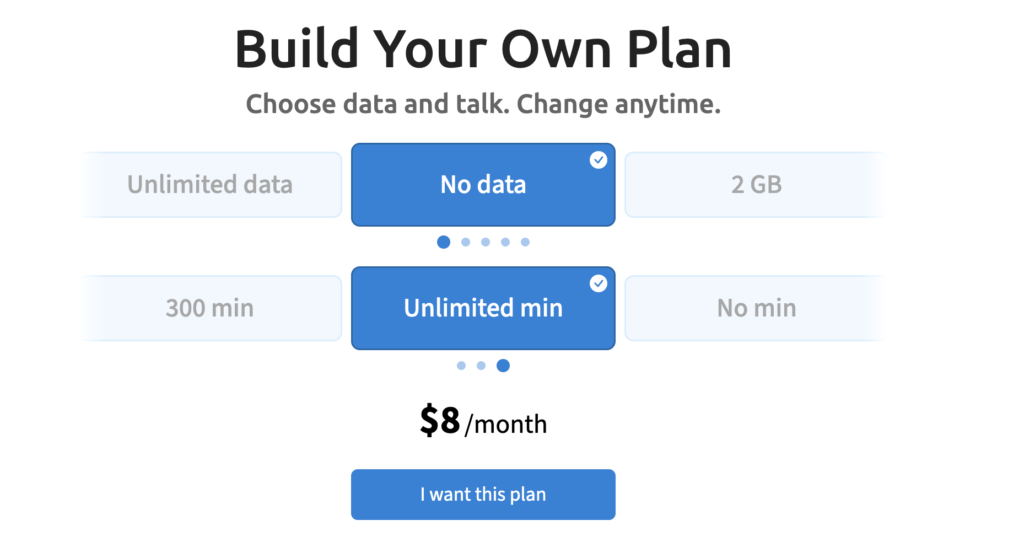
For my own plan, I pay $8 a month: unlimited minutes, which cover calls to the 60-plus countries on Tello’s free list, and no data. I left the data off on purpose. My local SIM already handles that, and I was not about to pay for it twice. If you do want data on your US line, you add it, and the price climbs to match what you build. I did not need to.
The exception is when I fly back to the US. I log into my Tello account, add data for that one month, and switch back to my minutes plan when I leave. Changing plans takes a minute, and Tello does not penalize you for it. So I get full data the whole time I am home, then stop paying for it the day I go.
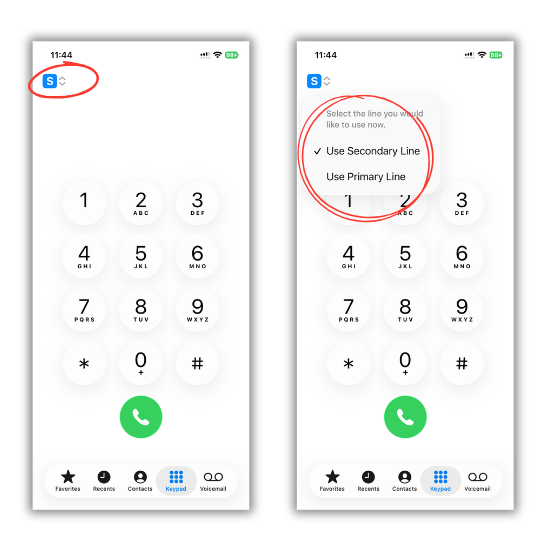
Tello lives on my phone as an eSIM, which is what makes the two-number setup possible. The eSIM carries my US number, and the physical slot takes my local SIM, Albanian at home or whatever country I am in. No swapping cards. No second phone.
What I use it for: keeping my US phone number alive, and catching the texts that number still has to catch. Two-factor codes. Bank logins. The verification texts from US accounts that will not send to a foreign number. And when I land back in the US, it is already working. I walk off the plane with a phone, my old US phone number, and data, nothing to set up and nothing to reactivate.
What I do not use it for: data abroad. My Albanian SIM, or a local one when I travel, does that far cheaper. Tello is not my everyday line. It is my US line, and it has one job.
The US phone number sits there. It stays alive. And when a US account needs to check it’s me, the code comes through. That is the entire job, and it does it for a fraction of what I used to pay.
Does Tello work abroad? My experience using it in Albania
Yes. I am using it from Saranda as I write this. But there is one setup detail I want to be honest about, because Tello’s own instructions and my actual experience do not perfectly line up.
Once you are abroad, the way you use Tello is Wi-Fi Calling. Your phone routes calls and texts over whatever wifi you are connected to, home, apartment, cafe, instead of over a cell tower. Wi-Fi Calling sends and receives both calls and texts, and that is the piece that matters most. It is why a bank verification text can still reach me in Albania over my home wifi.
Here is what Tello will tell you: Wi-Fi Calling is supposed to be switched on while your phone is connected to Tello’s network inside the US. That is the reliable path. If you are still stateside, set it up before you leave and test it on wifi before you fly. Do not overthink it.
My experience, though, is different. I did not do that. I found Tello when I was already living in Albania, and I set the whole thing up from here. It worked.
But I want to be straight about why, because it does not work for everyone. I was on strong, stable wifi and connected through a reputable VPN at the time; I used Surfshark, and I believe that is what got the activation through.
Setting up from abroad can fail, and when it fails, you are troubleshooting with support from another continent.
So here is my honest advice. If you are still in the US, set up Wi-Fi Calling there. It is the sure thing. If you are already abroad like I was, it may still go through on good wifi, but treat that as a maybe, not a promise, and have a backup for anything time-sensitive while you sort it out.
In my own use, it has been solid. My bank calls come through, my verification codes come through, over Albanian wifi, every time I have needed one. No issues.
One honest caveat, because I would rather over-inform you. I did come across a Reddit thread a couple of years back where someone could not receive a code on Tello and had their bank verify them by phone call instead.
That fixed it for them, and they had no trouble after. It has never happened to me, and I have no idea whether it was ever widespread or long since sorted.
But if a text code ever fails to land, the fix is easy. Set your bank to verify you by phone call rather than text. Calls ride the same Wi-Fi Calling, so they come through just fine.
Tello also has a paid international roaming option that uses cellular data abroad, billed from a pay-as-you-go balance. I rely on Wi-Fi Calling, not roaming. I have never used the roaming option myself, so I can only tell you it exists, not how well it works.
The honest limitations
Tello is not magic, and I would rather you hear the limits from me than find them the week you land.
It lives on wifi. No wifi, no service. When I am out at the beach or up in the mountains with no signal, my US number is simply asleep until I am back online.
For me that is fine, because I just use my local SIM card and it keeps me reachable everywhere I actually need to be. Usually nothing urgent runs through the US phone number on my day-to-day.
For you it might not be, so know it going in. Paid roaming is the only way around it, and I would not count on that. I have never used it myself, so treat it as a last resort, not a plan.
“Unlimited” does not mean unlimited. If you ever run Tello as a real data line, the unlimited plan gives you 50 GB at full speed and then slows you to much lower speeds, which is too slow for maps or video.
It never affects me, because I do not use Tello for data abroad. But if you plan to lean on it for data, back home in the US or anywhere else, do not picture endless high-speed internet.
Support is online only. There are no Tello stores to walk into. If something goes wrong, you are working through live chat and support tickets, which is worth remembering when you are sorting out a problem from another country.
Alternatives I looked at
Tello is what I use now, but it is not the only way to keep a US phone number. Here is my honest read on the others, labeled by whether I actually tried them or only weighed them up.
Google Voice
Google Voice is free, which is the whole appeal, and I did try it. It gives you a separate US phone number that takes calls and texts over the internet. I did not move my real number into it. I set up a fresh Google Voice number just to test whether it could do the job.
Two things sank it for me. The setup is clunky, and it has to be done inside the US or it will not work at all. I tried both in the US and from abroad, and across all those attempts I got it working exactly once. That is not a number you can trust to catch a bank code the moment you need it.
The bigger problem is what it is. Google Voice is a VoIP number, and a lot of US banks will not send verification codes to VoIP numbers at all. I called my own bank to ask, and they confirmed it directly: their codes will not go to a Google Voice number. So the one job I needed a US phone number to do, Google Voice could not do.
Free is great. Free is not great when it is this unreliable.
Keeping your old US carrier
The simplest option, but most expensive. You just keep paying your original US carrier and let the number ride. It works. But you are paying roughly $50 or more a month for a full plan you barely use, when a stripped-down number costs a few dollars. I was tired of burning that money every month. The math did not survive contact with reality.
Other options: Mint Mobile and Ultra Mobile
I have not used either of these, and I do not know anyone who has, so I cannot vouch for them the way I can for Tello. I am listing them as options, not recommendations.
If you look at either one, confirm it will actually deliver your bank and 2FA codes before you commit, because that is the whole reason for the number.
Mint Mobile runs on bulk prepaid. Plans start around $15 a month, but you pay upfront in 3, 6, or 12-month blocks, so the low monthly price arrives as one larger charge. International use is handled through a wallet balance on your account.
Ultra Mobile has a pay-as-you-go plan starting around $3 a month, on a physical SIM or an eSIM, and it runs over Wi-Fi Calling just like Tello. On paper, it is the closest alternative to Tello here.
So, is Tello worth it?
Here is where I land after doing this the expensive way first and the cheap way ever since. You do not need a full US carrier bill to stay reachable back home.
You need a US number that stays alive, catches your bank codes, and works over wifi wherever you are. For me, Tello does exactly that for $8 a month, and it has never let me down when it actually mattered.
It is not glamorous. Nobody warns you to sort this out before you move. But it is the quiet thread that keeps your American life reachable while you build a new one somewhere else.
Eight dollars a month to never get locked out of my own accounts from across the world. I will take that every time.
FAQ
Can I keep my US phone number while living abroad?
Yes. You can keep a US number from anywhere in the world by moving it onto a low-cost US carrier like Tello and using Wi-Fi Calling to send and receive over the internet. You do not have to keep paying a full US carrier plan to hold onto the number.
Can I keep my existing US number with Tello?
Yes, and it is what most people do. You port your current US number into Tello instead of taking the new one it offers. Before you start, turn off port protection on your old account, and have your account number and transfer PIN ready. Do not cancel your old carrier until the port completes, or you can lose the number. Once your old carrier releases it, the transfer itself takes about two minutes, and Tello emails you the moment it is done.
Does Tello work outside the US?
Yes, primarily through Wi-Fi Calling, which routes your calls and texts over any wifi connection. It also offers paid international roaming. The one rule that catches people: Wi-Fi Calling has to be enabled while your phone is on Tello’s US network, so set it up before you leave the country.
Will I still get bank verification and 2FA codes on Tello from abroad?
Yes. In my own use from Albania, my bank codes and 2FA texts come through over wifi every time I have needed them, because Wi-Fi Calling receives texts the same as any US phone would. If a code ever does not arrive, the easy fix is to set your bank to verify you by phone call instead, since calls come through on Wi-Fi Calling too. Just keep Wi-Fi Calling enabled and stay on stable wifi.
Does Tello work over wifi?
Yes. Wi-Fi Calling is the main way you use Tello abroad. As long as you are connected to a stable wifi network and enabled the feature before you left the US, you can make and receive calls and texts over that wifi without a local cell signal.
How much does Tello cost per month?
Plans start at $5 a month because you build your own from minutes, texts, and data, with no contract. I pay $8 a month for unlimited minutes and no data, since my local SIM handles the data and the number is really there to catch calls and codes. Most expats do not need much. If you do want data on your US line, you add it, and the price adjusts to match.
Is Tello better than Google Voice for expats?
Tello is a genuine cellular number on a real plan, so it receives bank and verification texts through Wi-Fi Calling the way any normal number would. Google Voice is free but is a VoIP number that some US institutions reject for verification. If receiving codes is the whole point, that difference is the answer.